
Screen Time for Toddlers — What Australian Experts Say
Screen Time for Toddlers — What Australian Experts Actually Say
Reading time: 6 minutes
Few topics cause more parental guilt than screen time for toddlers. If you have ever handed your child an iPad at a restaurant just to get through a meal, or relied on a few episodes of Bluey while you cooked dinner, you are not a bad parent. You are a normal one. But if you are wondering what the actual Australian guidelines say about screen time for toddlers — and what the research really shows — this article will give you the facts without the judgment.
What Are the Australian Screen Time Guidelines?
The Australian Government Department of Health publishes physical activity and sedentary behaviour guidelines for children. Here is what they recommend for young children:
- Under 2 years: No screen time at all (except video calling with family)
- 2-5 years: No more than one hour per day of sedentary screen time
- 5-12 years: No more than two hours of recreational screen time per day
These guidelines are consistent with recommendations from the World Health Organisation and the Royal Australian College of General Practitioners.
It is worth understanding what "screen time" means in this context. The guidelines are referring to sedentary screen time — sitting and watching passively. They are not necessarily talking about interactive video calls with grandparents, co-watching an educational program with a parent, or brief, purposeful use of age-appropriate apps.
What Does the Research Actually Show?
The relationship between screen time and child development is more nuanced than the headlines suggest. Here is what large-scale Australian and international studies have found:
The Concerns Are Real
- Language delays: A 2023 study published in JAMA Pediatrics found that each additional hour of daily screen time at age one was associated with a 40% increased risk of expressive language delay by age two.
- Sleep disruption: Screen use in the hour before bedtime is consistently linked to poorer sleep quality and shorter sleep duration in young children.
- Attention and behaviour: Some studies link excessive screen time (more than two hours per day) in toddlers with attention difficulties and behavioural issues in later childhood.
- Physical activity displacement: Time spent on screens is time not spent moving, climbing, building, and engaging in gross motor play.
But Context Matters
- Co-viewing changes everything. When a parent watches a program with a child and talks about what is happening, children learn more than when they watch alone. Bluey watched together with conversation is a very different experience from YouTube autoplay in a high chair.
- Content quality matters. Slow-paced, narrative-driven programs (like Bluey, Play School, or Sesame Street) are associated with better outcomes than fast-paced, sensory-overload content.
- Interactive use is different from passive watching. A three-year-old doing a guided drawing app with a parent is not the same as a three-year-old watching unboxing videos.
- Occasional flexibility is fine. One study from the University of Oxford found that moderate screen use had no measurable negative impact on child wellbeing. The key word is "moderate."
Practical Tips for Managing Screen Time
1. Focus on Quality Over Quantity
Rather than obsessing over exact minutes, focus on what your child is watching and how they are watching it. Choose age-appropriate, educational content and watch it together when you can.
2. Set a Routine, Not a Rule
Instead of saying "only 30 minutes," build screen time into a predictable part of the day. For example, one episode of Bluey after lunch while you clean up. Routine reduces negotiation and tantrums.
3. Protect the Last Hour Before Bed
This is the one area where the research is very clear. Screens before bed disrupt melatonin production and make it harder for children to fall asleep. Switch to books, quiet play, or bath time in the hour before bed.
4. Create Screen-Free Zones
Meals, the car (for short trips), and the bedroom are good places to keep screen-free. These are also the times when family conversation and observation of the world are most valuable.
5. Model the Behaviour You Want
Children learn from watching us. If you are on your phone constantly, your toddler will want to be on a screen too. Try putting your phone away during play time and meals — it benefits your relationship and shows your child that the real world is more interesting than a screen.
6. Offer Alternatives
Many parents reach for a screen because they need a few minutes of peace. Build a "busy box" of activities that can occupy your child independently — playdough, colouring, stickers, a water pouring station, or a basket of interesting objects. These buy you time without a screen.
7. Let Go of Guilt
If your child has watched more than an hour of TV today because you were sick, working from home, or just exhausted — that is okay. One day of extra screen time does not undo weeks of engaged parenting. The overall pattern matters far more than any single day.
What Happens at Childcare?
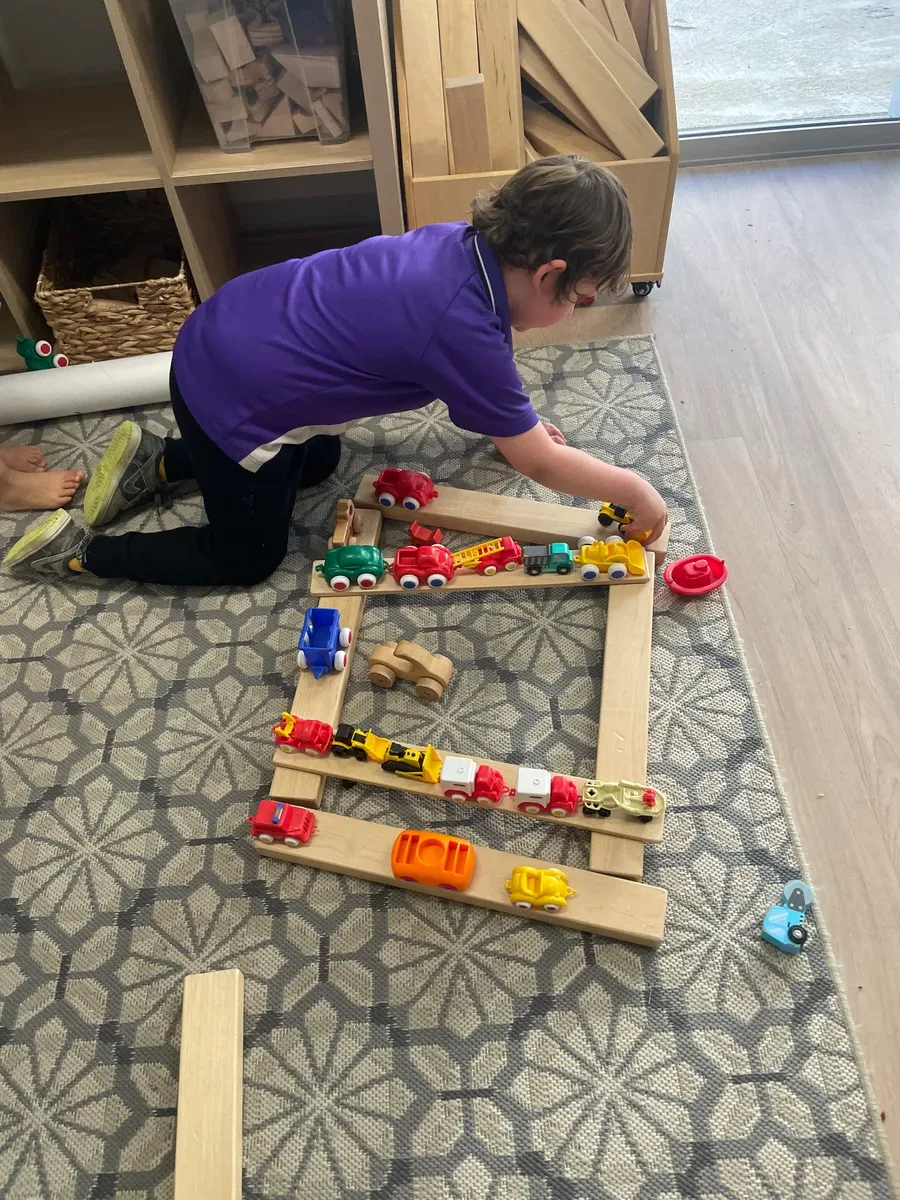
Under the National Quality Framework, approved childcare centres in Australia are expected to minimise or eliminate screen use for children in care. At Sonas Woodbridge, we are a screen-free environment. Our children spend their days in hands-on, play-based learning across our studios — The Nest, The Zen, The STEM Studio, The Arts Studio, The Garden, and The Family Room.
Our Nestlings and Swaylings engage with real objects, real people, and real experiences. Our Explorers and Pathfinders learn through sensory play, construction, art, music, movement, and nature. We believe that young brains develop best through three-dimensional, multi-sensory experiences that no screen can replicate.
This does not mean we judge families who use screens at home. We understand the reality of modern parenting. But we do believe that the hours your child spends with us should be rich with the kind of play and connection that builds the strongest foundations.
Key Takeaways
- Australian guidelines recommend zero screen time for under-twos and a maximum of one hour per day for children aged two to five
- Co-viewing, content quality, and interactive use all change the impact of screen time significantly
- Protect the hour before bedtime — this is the most important screen-free window
- Focus on overall patterns rather than obsessing over individual days
- Quality childcare centres like Sonas Woodbridge provide screen-free, play-based environments that support healthy development
Ready to see play-based learning in action? Book a tour at Sonas Woodbridge or call us on (08) 6184 6055.
See play-based learning in action
Book a free tour at any of our 4 Perth centres.