
Speech Development Milestones — When Should My Toddler Talk?
Speech Development Milestones — When Should My Toddler Be Talking?
Reading time: 8 minutes
If you have ever found yourself Googling "when should my toddler be talking" at 11pm, you are not alone. Speech development milestones are one of the most common concerns for Australian parents, and it is completely natural to compare your child's language to others their age.
The truth is that speech and language development varies enormously between children. Some toddlers are chatting in sentences by 18 months while others are still pointing and grunting well past two. Both can be perfectly normal. But understanding the general milestones — and knowing when to seek help — gives you the confidence to support your child's communication journey.
Understanding the Difference: Speech vs Language
Before we look at milestones, it is important to understand two different things:
Speech refers to the physical ability to produce sounds and words. It is about articulation, fluency, and voice.
Language refers to the ability to understand and use words to communicate. It includes receptive language (what your child understands) and expressive language (what your child says or communicates).
A child can have strong language skills but unclear speech, or clear speech but limited vocabulary. Both are important, and they develop somewhat independently.
Speech and Language Milestones by Age
These milestones are based on guidelines from Speech Pathology Australia and the Raising Children Network. Remember, these are general guides — there is a wide range of normal.
0-6 Months
- Startles at loud sounds
- Coos and makes vowel sounds ("aah," "ooh")
- Turns toward voices and sounds
- Begins to babble with consonant sounds ("ba," "ma")
- Laughs and squeals
- Makes different cries for different needs
6-12 Months
- Babbles with varied sounds ("bababa," "mamama," "dadada")
- Responds to their name
- Understands "no" and simple instructions with gestures
- Points to things they want
- May say first words ("mama," "dada," "bye-bye") around 12 months
- Uses gestures like waving and clapping
- Imitates sounds and actions
12-18 Months
- Says 6-20 words (though these may not all be clear)
- Understands more words than they can say (receptive language is ahead of expressive)
- Points to familiar objects when named ("Where's the dog?")
- Follows simple instructions ("Give it to Mummy")
- Tries to copy words
- Uses gestures alongside words
- May use "jargon" — babbling that sounds like conversation with intonation and rhythm
18-24 Months
- Uses 50+ words
- Begins combining two words ("more milk," "Daddy go," "big truck")
- Follows two-step instructions ("Pick up the ball and give it to me")
- Points to body parts when asked
- Uses words to express needs rather than just crying or pointing
- Strangers can understand about 50 percent of what they say
- Asks simple questions ("What that?")
2-3 Years
- Uses 200-1000+ words
- Speaks in sentences of 3-4 words
- Asks "why" and "what" questions (prepare yourself)
- Can be understood by strangers about 75 percent of the time
- Uses pronouns (I, you, me, mine)
- Follows multi-step instructions
- Engages in simple conversations
- Talks about things that happened in the past
- Begins to use plurals and past tense
3-4 Years
- Speaks in sentences of 4-6 words
- Tells simple stories
- Can be understood by strangers most of the time
- Asks lots of questions
- Understands concepts like "same" and "different," "big" and "little"
- Uses grammar more accurately (though errors are still normal and expected)
- Enjoys rhyming and word play
When Should You Be Concerned?
While there is a wide range of normal, Speech Pathology Australia recommends seeking professional advice if your child:
- By 12 months: Is not babbling, not using gestures (pointing, waving), or not responding to their name
- By 18 months: Has fewer than 6 words, does not understand simple instructions, or has lost words they previously used
- By 2 years: Uses fewer than 50 words, is not combining two words, or cannot be understood by familiar people
- By 3 years: Is not using sentences, cannot be understood by strangers, or is becoming frustrated by their inability to communicate
- At any age: Loses language skills they previously had (this warrants immediate attention)
If you have a gut feeling that something is not right, trust it. Early intervention for speech and language delays is incredibly effective. In Western Australia, you can access support through:
- Your GP — for a referral to a speech pathologist
- Child Development Service WA (formerly Child Development Centres) — free government-funded assessments
- Private speech pathologists — many in the Perth metro area, some with shorter wait times
- Telethon Kids Institute — research and resources on child development
What Causes Speech Delays?
Speech and language delays can happen for many reasons, and often there is no single cause:
- Hearing issues — even mild or temporary hearing loss (like from recurrent ear infections, which are very common in WA's climate) can impact speech
- Developmental factors — some children are simply later talkers who catch up on their own
- Environmental factors — limited exposure to conversation and language-rich environments
- Multilingual homes — children learning two or more languages may appear "slower" initially but are actually developing multiple language systems simultaneously (this is not a delay)
- Developmental conditions — autism spectrum, intellectual disability, or specific language impairment may affect speech and language
8 Ways to Support Your Toddler's Speech at Home
-
Talk constantly. Narrate your day: "Now we're putting on your shoes. One shoe... two shoes! Let's go to the car." This floods your child with language.
-
Read together every day. Books are one of the most powerful language-building tools. Point to pictures, ask questions, and let your child turn the pages.
-
Follow their lead. If your child is interested in the dog, talk about the dog. Language grows fastest when it is connected to something the child is already engaged with.
-
Expand on what they say. If your child says "truck," you say "Yes, a big red truck! The truck is driving fast." This models richer language without correcting them.
-
Reduce screen time. The Australian Department of Health recommends no screen time for children under 2 and no more than one hour per day for children 2-5. Screens do not build language the way human interaction does.
-
Sing songs and nursery rhymes. Repetitive songs build vocabulary, rhythm, and memory. Aussie classics like "Kookaburra Sits in the Old Gum Tree" are perfect.
-
Give them time to respond. After asking a question, wait at least 5 seconds. Toddlers need processing time. Resist the urge to answer for them.
-
Play, play, play. Play is the language of childhood. Pretend play, in particular, explodes language development — tea parties, dolls, cars, shops, cooking.
How Sonas Woodbridge Supports Speech and Language Development
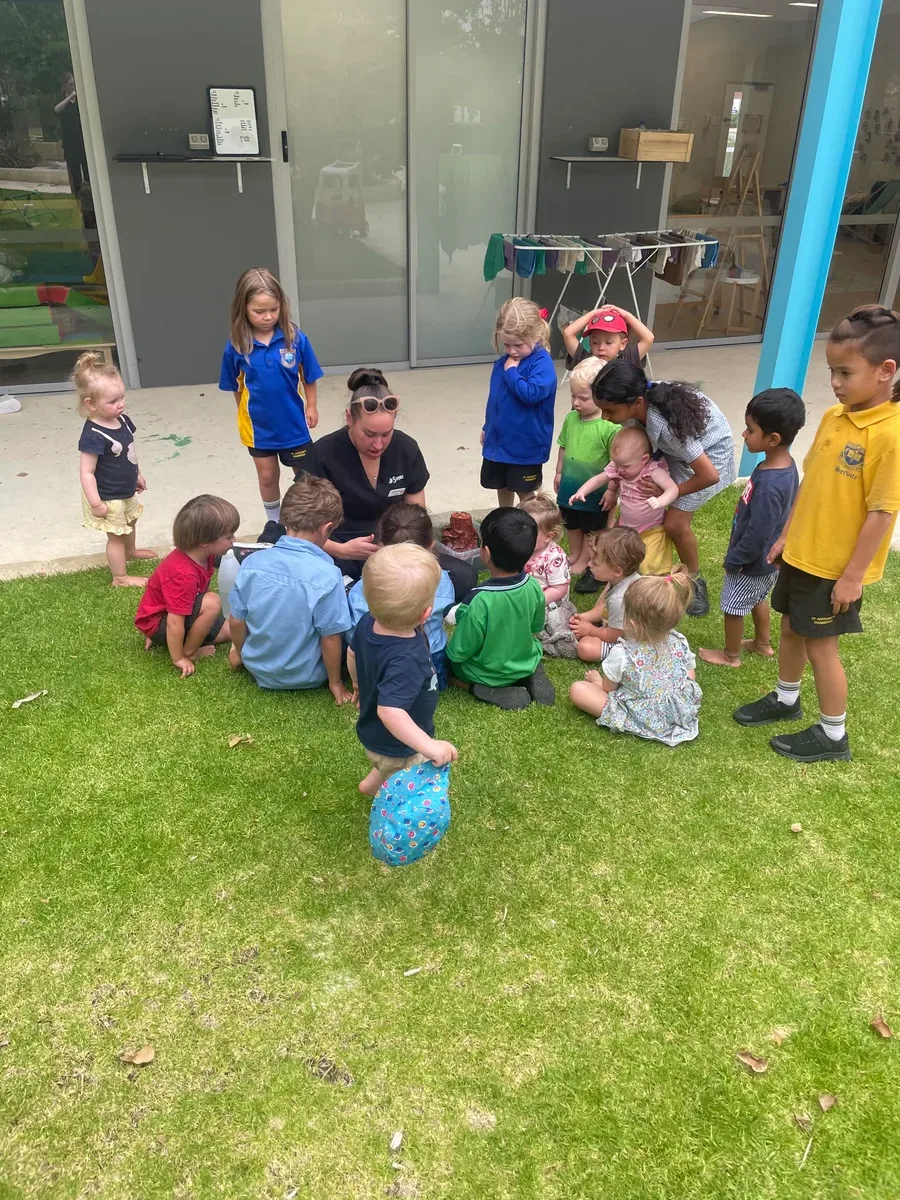
At Sonas Woodbridge, language development is embedded in everything we do. Our play-based, child-led approach creates a language-rich environment where children are surrounded by meaningful conversation, stories, songs, and responsive educators.
In The Nest, our Nestlings educators narrate routines, sing during nappy changes, and respond to every babble and gesture. This builds the foundation of communication from the earliest days.
In The Family Room, our family grouping model means younger children hear and learn from older children's more advanced language. This natural mentoring accelerates speech development in a way that same-age groupings cannot replicate.
In The Arts Studio and STEM Studio, children are encouraged to describe what they are creating, explain their thinking, and share their ideas with peers. This develops expressive language in authentic, meaningful contexts.
Our educators are trained to recognise when a child may benefit from additional speech and language support, and we work closely with families to connect them with appropriate services. We also collaborate with visiting speech pathologists when families request it.
Key Takeaways
- Speech development varies widely — there is a broad range of normal
- By 12 months, most children babble and use gestures; by 2, most use 50+ words and combine two words
- Trust your instincts — if something feels off, seek professional advice early
- Hearing should be checked if there are any speech concerns
- Talk, read, sing, and play with your child every day — these are the most powerful language builders
- At Sonas Woodbridge, language-rich environments and responsive educators support every child's communication journey
Concerned about your child's speech? Our educators are here to help. Book a tour at Sonas Woodbridge or call (08) 6184 6055.
See play-based learning in action
Book a free tour at any of our 4 Perth centres.