
Why Outdoor Play Is the Best Thing for Your Child's Development
Why Outdoor Play Is the Best Thing for Your Child's Development
Reading time: 7 minutes
If you could give your child one thing that improves their physical health, strengthens their immune system, boosts their concentration, reduces anxiety, develops their social skills, and makes them happier — would you? That thing already exists, it is completely free, and Perth has it in abundance. It is outdoor play.
In a world of increasing screen time, structured activities, and indoor entertainment, the simple act of letting children play outside — freely, regularly, and with minimal adult direction — is one of the most powerful things you can do for their development. The research is clear, and the benefits are profound.
What the Research Says
Physical Health
The Australian Government's Physical Activity Guidelines recommend that children aged one to five get at least three hours of physical activity every day, including energetic play. Outdoor environments naturally encourage running, jumping, climbing, balancing, and crawling — movements that build gross motor skills, strengthen bones and muscles, and develop coordination.
A 2022 study from the University of Western Australia found that children who spend more time in unstructured outdoor play have better cardiovascular fitness, lower obesity risk, and stronger bone density than their indoor-focused peers.
Cognitive Development
Outdoor play is not just physical — it is deeply cognitive. Natural environments are complex, unpredictable, and rich with opportunities for problem-solving. A child navigating tree roots, building a dam in a creek, or figuring out how to climb a rock is engaging executive function, spatial reasoning, and creative thinking.
Research from the University of British Columbia shows that nature-based play improves attention span and reduces symptoms of ADHD. Children who play outside regularly demonstrate better concentration, memory, and impulse control in classroom settings.
Emotional and Mental Health
The mental health benefits of outdoor play are striking. A landmark study from Deakin University found that children who spend more time in natural environments have lower rates of anxiety, depression, and emotional difficulties. Nature has a regulatory effect on the nervous system — lowering cortisol (the stress hormone) and promoting a calm, focused state.
For young children, outdoor play also builds resilience. Climbing something a little scary, getting muddy, falling down and getting up again — these are small acts of bravery that develop emotional strength and self-confidence.
Social Development
Outdoor play tends to be more collaborative and less rule-bound than indoor play. When children play outside, they negotiate roles, share resources, solve conflicts, and create imaginary worlds together. The physical space allows for parallel play, group games, and solitary exploration side by side — supporting children at every social development stage.
Immune System
The "hygiene hypothesis" is well established in immunology: children who are exposed to diverse microorganisms in natural environments develop stronger immune systems. Playing in dirt, touching plants, and spending time outdoors exposes children to beneficial bacteria that support gut health and immune function.
A Finnish study published in 2020 found that children who played in a forest-floor environment daily showed measurable improvements in immune markers within just 28 days.
Sensory Development
Outdoor environments are multi-sensory in ways that indoor spaces simply cannot replicate. The feeling of wind, the sound of birds, the smell of rain on earth, the texture of bark, the warmth of sun on skin — these experiences stimulate neural development and build sensory integration, which is the brain's ability to process and respond to multiple sensory inputs at once.
Why Perth Families Have an Advantage
Living in Perth means you have access to one of the best outdoor environments for children in the world. With over 260 days of sunshine per year, beautiful beaches, bushland, rivers, and parks on your doorstep, there is no excuse not to get outside — and now that spring has arrived, conditions are perfect.
Some of our favourite outdoor spaces near Woodbridge for families with young children:
- Bells Rapids, Brigadoon — beautiful walking trails along the Swan River, suitable for sturdy toddlers with a carrier for the little ones
- John Forrest National Park — wildflowers in spring, gentle bush trails, and a swimming pool for warmer days
- Whiteman Park — free entry, playground, train rides, and bushland walks
- Lilac Hill Park, Caversham — flat, grassy, perfect for toddlers to run freely
- The Swan Valley — combine a family walk with a stop at one of the kid-friendly cafes or farms
- Your own backyard — honestly, children do not need a national park. A patch of grass, some mud, a bucket of water, and a few sticks is enough.
How Much Outdoor Time Do Children Need?
The Australian guidelines are clear:
- 0-1 year: Floor-based play in safe outdoor environments, supervised tummy time on grass
- 1-2 years: At least three hours of physical activity spread throughout the day, including outdoor play
- 3-5 years: At least three hours of physical activity, including at least one hour of energetic play (running, jumping, climbing)
In practice, this means children should be outside for a significant portion of every day — not just a quick trip to the park, but extended time where they can explore at their own pace.
The Role of Risky Play
One of the most important aspects of outdoor play is something that makes many modern parents uncomfortable: risk.
Risky play — climbing high, balancing on uneven surfaces, playing near water, using real tools — is essential for healthy development. It teaches children to assess danger, manage their own safety, and build physical confidence. Children who are protected from all risk do not learn to manage it, which can lead to greater anxiety and injury later in life.
This does not mean letting your child do anything dangerous. It means stepping back, resisting the urge to say "be careful" every thirty seconds, and trusting that your child is learning to navigate the world.
The trick is to assess: "What is the worst that could happen?" If the answer is a scraped knee or a bruise, it is probably worth letting them try. If the answer is a serious injury, intervene.
Common Barriers (and How to Overcome Them)
"It is too cold/hot/rainy"
In Perth, we are blessed with mild weather most of the year. On cooler days, layer up. On hot days, play early in the morning or late in the afternoon. On rainy days — let them get wet. Children love rain, and waterproof jackets exist for a reason.
"I do not have a backyard"
Parks, nature reserves, and playgrounds are all accessible. Even a walk around the block counts. Many Perth suburbs have beautiful street trees, verges, and small green spaces that are perfect for little explorers.
"They get bored outside"
This usually passes. Children who are used to high-stimulation indoor entertainment may need time to adjust. Give them unstructured time outside without toys or direction, and watch their imagination take over. It might take 10-15 minutes of "I'm bored" before the magic starts.
"I am worried about safety"
Supervised outdoor play is very safe. Teach your child about sun safety, water safety, and basic road awareness. Then let them play.
How Sonas Woodbridge Prioritises Outdoor Play
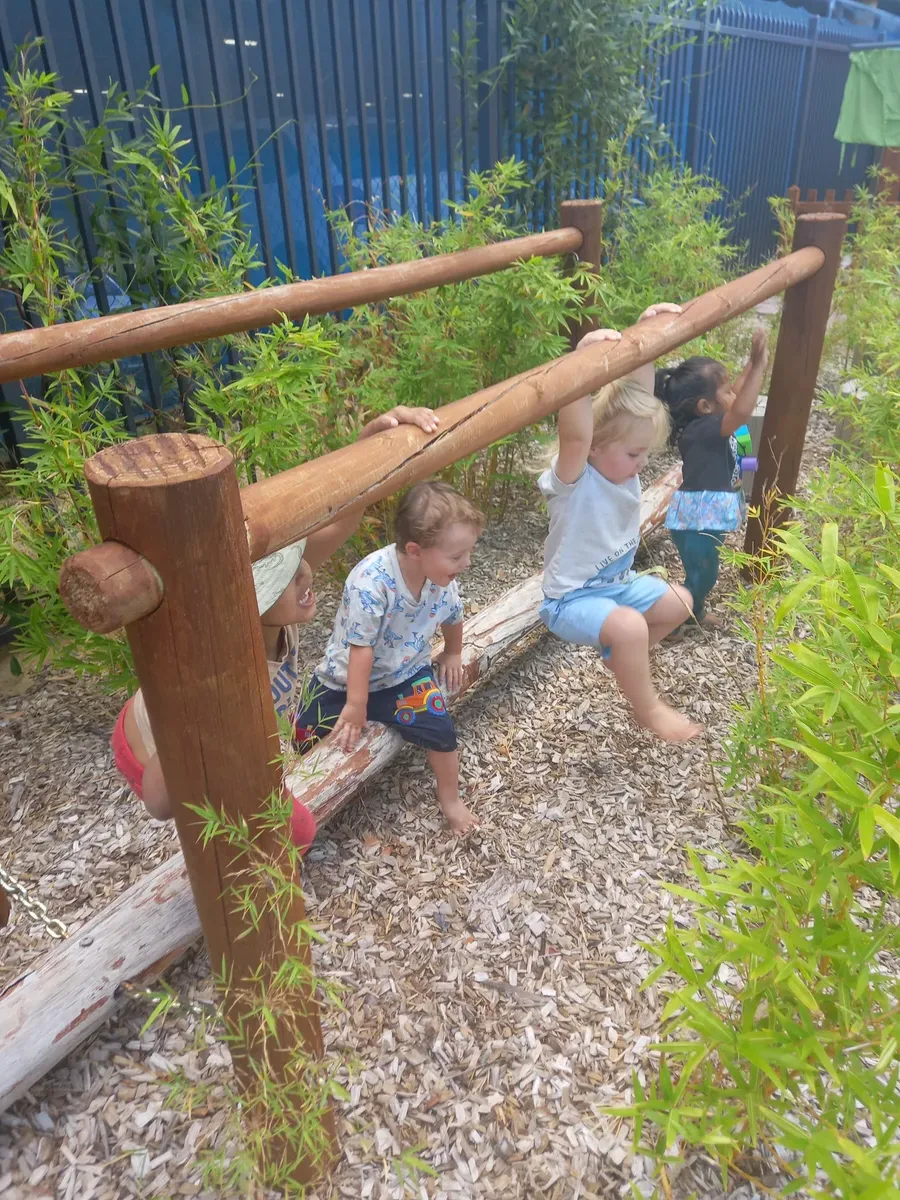
At Sonas Woodbridge, outdoor play is not an afterthought — it is central to our philosophy. Our Garden studio provides a rich natural play environment with sand, water, mud, climbing structures, garden beds, and open spaces for running and imaginative play.
Our educators take children outside every day, in all weather (within reason). We believe that children have the right to experience fresh air, sunshine, wind, and rain as part of their daily learning. Our play-based curriculum means that outdoor time is not just "free time" — it is where some of the deepest learning happens.
From our Nestlings enjoying tummy time on grass to our Pathfinders building cubby houses and investigating insects, every age group at Sonas Woodbridge benefits from generous, daily outdoor play.
Key Takeaways
- Outdoor play improves physical health, cognitive development, emotional wellbeing, social skills, and immune function
- Australian guidelines recommend at least three hours of physical activity daily for children aged one to five
- Perth families have an extraordinary natural environment — use it
- Risky play is essential for healthy development — step back and let them climb
- Children do not need expensive outdoor equipment — sticks, mud, water, and space are enough
- Quality childcare centres prioritise daily outdoor play in natural environments
Ready to see play-based learning in action? Book a tour at Sonas Woodbridge or call us on (08) 6184 6055.
See play-based learning in action
Book a free tour at any of our 4 Perth centres.