
The Benefits of Play-Based Learning — What the Research Says
The Benefits of Play-Based Learning — What the Research Says
Reading time: 6 minutes
"They just play all day." If you've ever had that thought about your child's daycare experience, you're not alone. For parents who remember structured school environments with desks, worksheets, and formal instruction, a play-based approach can look like "just playing." But here's what three decades of research tells us: play IS learning. It's not a break from learning, a reward for learning, or a precursor to "real" learning. For young children, play is the most powerful, natural, and effective way to develop the skills they'll need for the rest of their lives.
At Sonas Woodbridge, play-based learning is the foundation of everything we do. It's not a buzzword for us — it's a deeply held philosophy backed by evidence. Let's look at what the research actually says.
What Is Play-Based Learning?
Play-based learning is an educational approach where children learn through play experiences that are meaningful, joyful, actively engaging, iterative, and socially interactive. It's the approach recommended by the Early Years Learning Framework (EYLF), which guides all Australian early childhood services.
There are two types of play in quality early childhood settings:
- Child-initiated play — where children choose what to do, how to do it, and who to do it with. The educator observes, supports, and extends the play when appropriate.
- Guided play — where the educator sets up the environment or introduces an activity with a learning intention, but children still have freedom within it.
Both are essential. And both look nothing like sitting at a desk filling in worksheets.
What the Research Says
1. Play Builds Stronger Brains
Neuroscience research has confirmed what early childhood educators have known for decades: play physically changes the brain. A landmark review published in The Lancet (2017) found that play — particularly in early childhood — stimulates the development of neural pathways in the prefrontal cortex, the area of the brain responsible for decision-making, problem-solving, emotional regulation, and social behaviour.
When a child builds a tower of blocks, their brain is practising spatial reasoning, physics, and persistence. When that tower falls and they rebuild, they're developing resilience. When they negotiate with another child over who gets the red block, they're practising conflict resolution.
2. Play Develops Language and Literacy
A major study by Weisberg, Hirsh-Pasek & Golinkoff (2013) found that children in play-based learning environments showed significantly stronger vocabulary development and literacy readiness than children in direct-instruction settings.
Why? Because play creates natural, meaningful contexts for language. During dramatic play ("You be the doctor, I'll be the patient"), children use complex sentences, negotiate roles, and create narratives. During storytime and book exploration, they build comprehension and a love of reading. During show-and-tell or conversations at the lunch table, they practise expressive language.
3. Play Develops Social and Emotional Skills
The Australian Early Development Census (AEDC) consistently identifies social and emotional development as a critical factor in school readiness. Play is where children learn to:
- Share, take turns, and cooperate
- Understand and manage their own emotions
- Read social cues and respond appropriately
- Resolve conflicts
- Develop empathy by seeing things from another's perspective
These are not skills that can be taught through worksheets. They are learned through lived experience — which is exactly what play provides.
4. Play Supports Physical Development
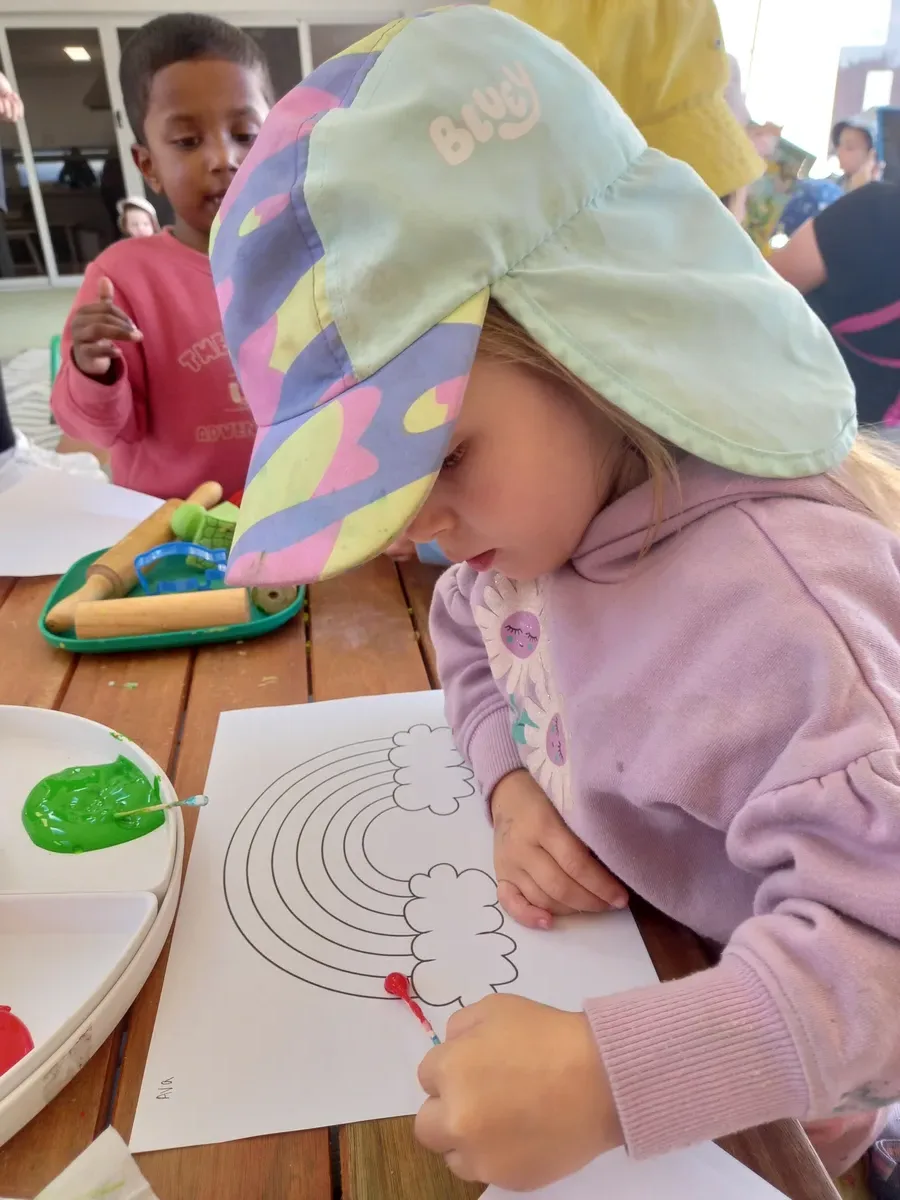
Active play — running, climbing, jumping, digging, crawling, balancing — develops gross motor skills, coordination, and body awareness. Fine motor play — threading, cutting, painting, manipulating playdough — builds the hand strength and dexterity children need for writing.
The Australian Government's Physical Activity and Sedentary Behaviour Guidelines recommend that children aged 1-5 are physically active for at least three hours per day, spread throughout the day. In a play-based setting, physical activity is naturally embedded — not confined to a 30-minute "PE lesson."
5. Play Fosters Creativity and Problem-Solving
When children play, they are constantly creating, testing, and revising. Open-ended play materials (blocks, loose parts, natural materials, art supplies) invite children to think divergently — to imagine possibilities rather than find a single correct answer.
A study by Russ (2004) found that children who engaged in pretend play showed higher levels of creative thinking, both during play and in unrelated tasks. Creativity isn't just about art — it's a fundamental skill for innovation, adaptability, and problem-solving throughout life.
6. Play Creates Intrinsic Motivation for Learning
Perhaps the most important finding of all: children who learn through play develop a love of learning itself. Research by Lillard et al. (2013) in the journal Psychological Science in the Public Interest found that play-based approaches nurture intrinsic motivation — the internal drive to explore, discover, and understand.
Children who are intrinsically motivated don't learn because they're told to. They learn because they want to. And that motivation carries through into school and beyond.
But What About School Readiness?
This is the question many Perth parents ask: "Will my child be ready for school if they're 'just playing' at daycare?"
The answer, according to the evidence, is a definitive yes — in fact, they may be more prepared than children from academic-focused programs.
A longitudinal study by Marcon (2002) compared children from play-based preschools with children from academically-focused preschools. By the end of Year 3, children from play-based programs had caught up academically and surpassed their peers in social skills, motivation, and overall adjustment.
The skills that matter for school readiness — concentration, self-regulation, social competence, curiosity, confidence, and resilience — are all developed most effectively through play.
How Sonas Woodbridge Puts Play Into Practice
At Sonas Woodbridge, our play-based learning approach comes to life across our purpose-designed Learning Studios:
- The Nest — a calm, sensory-rich space for our youngest children (Nestlings, 0-1) to explore through touch, sound, and movement.
- The STEM Studio — where children experiment with building, measuring, cause-and-effect, and problem-solving through hands-on materials.
- The Arts Studio — a creative space for painting, sculpting, music, and dramatic play.
- The Garden — our outdoor learning environment where children dig, plant, climb, and discover the natural world.
- The Zen — a quiet space for mindfulness, relaxation, and sensory regulation.
- The Family Room — where we come together for shared meals, storytime, and community.
Our educators are trained to observe each child, identify their interests and developmental stage, and create play experiences that extend their learning. It's intentional, it's documented, and it's deeply effective.
Every time your child builds a sandcastle, paints a picture, or plays "shops" with their friends, they're learning. And we have the research to prove it.
Key Takeaways
- Play-based learning is the approach recommended by the EYLF and backed by decades of research.
- Play builds neural pathways, develops language, strengthens social-emotional skills, and fosters creativity.
- Children from play-based programs are as prepared (or more) for school as those from academic-focused programs.
- Play creates intrinsic motivation — children learn because they want to, not because they're told to.
- Quality play-based learning is intentional and guided by qualified educators who observe and extend each child's interests.
Ready to see play-based learning in action? Book a tour at Sonas Woodbridge or call us on (08) 6184 6055.
See play-based learning in action
Book a free tour at any of our 4 Perth centres.